
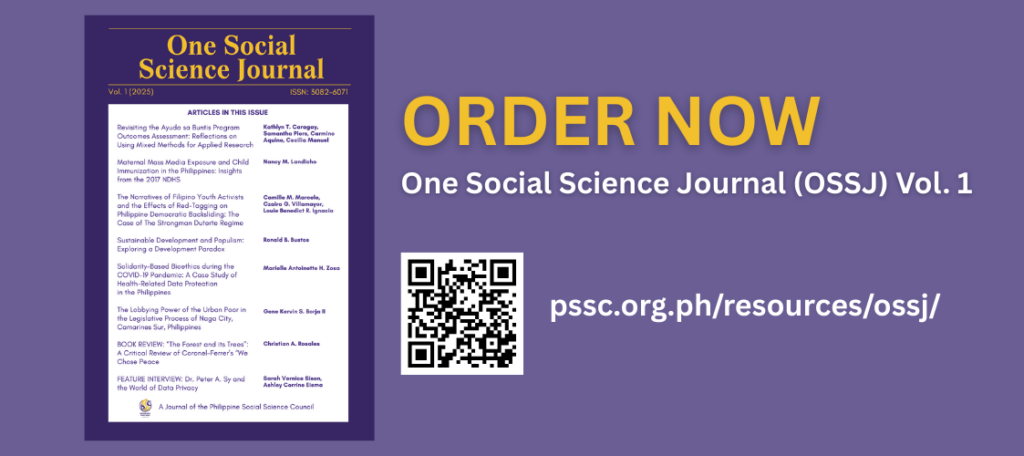
One Social Science Journal
Aim and Scope
The One Social Science Journal (OSSJ) invites theoretical and empirical articles across the social sciences. Papers addressing social issues are welcome. Book reviews are also accepted.
The OSSJ is the journal of the Philippine Social Science Council (PSSC), established as an integrative platform that showcases the breadth, depth, and interdisciplinary quality of high-caliber social science research in the Philippines.
Publication Information
The OSSJ is a peer-reviewed journal published every year. A searchable database of published articles and their abstracts is available at the PSSC website.
Subscription Information
Subscription may be sent to the following:
- Email: ossj@pssc.org.ph
- 2nd Floor, Philippine Social Science Center, 372-C Commonwealth Avenue, Brgy. UP Campus, Diliman, Quezon City, Philippines 1101
- Phone: (632) 8-929-2671
Submissions
Authors may submit their manuscripts to the following:
- Email: ossj@pssc.org.ph
- The Editor, One Social Science Journal, 2nd Floor, Philippine Social Science Center, 372-C Commonwealth Avenue, Brgy. UP Campus, Diliman, Quezon City, Philippines 1101
Copyright
The OSSJ is protected by Philippine copyright laws. Articles appearing herein may be reproduced for personal use but not for mass circulation. To reprint an article from OSSJ, permission from the editor must be sought.
Editorial Policy
1. Editorial Scope and Objectives
The One Social Science Journal is a peer reviewed, interdisciplinary journal dedicated to advancing high quality research across the social sciences. The journal publishes original research articles, review essays, and thematic issues that contribute to scholarly knowledge, policy discourse, and social development in the Philippines, the Asia Pacific region, and beyond.
OSSJ promotes methodological rigor, theoretical innovation, and ethical research practices. Submissions are evaluated solely on scholarly merit, originality, relevance, and clarity.
2. Editorial Independence
OSSJ maintains full editorial independence. Editorial decisions are made without influence from the publisher, sponsors, funders, or external organizations. The Editor-in-Chief has final authority over all editorial content and decisions.
3. Peer Review Process
OSSJ employs a double blind peer review process.
All submitted manuscripts undergo an initial screening by the Editor-in-Chief or the IssueEditor to assess scope, quality, and compliance with submission guidelines. Manuscripts that pass initial screening are sent to at least two independent reviewers with relevant expertise. Reviewers evaluate manuscripts based on originality, methodological soundness, theoretical contribution, ethical compliance, and clarity of presentation. Based on reviewers’ reports, the Editor-in-Chief makes one of the following decisions: accept, accept with minor revisions, revise and resubmit, or reject.
4. Editorial Decision Making
Final editorial decisions rest with the Editor-in-Chief, taking into account reviewers’ recommendations and editorial judgment. Decisions are communicated to authors in a timely and transparent manner. Appeals may be submitted in writing and will be reviewed by the Editor-in-Chief in consultation with the Editorial Board when necessary.
5. Ethical Standards and Malpractice
OSSJ adheres to the principles and best practices of the Committee on Publication Ethics.
Authors, editors, and reviewers are expected to uphold the highest standards of publication ethics. This includes avoiding plagiarism, data fabrication, falsification, duplicate publication, and undisclosed conflicts of interest.
Allegations of misconduct are investigated in accordance with COPE guidelines. Where misconduct is confirmed, appropriate actions may include rejection, retraction, publication of corrections, or notification of relevant institutions.
6. Conflicts of Interest
Authors must disclose any financial or non financial conflicts of interest that may influence their work. Editors and reviewers must recuse themselves from handling manuscripts where conflicts of interest exist.
7. Authorship and Contributions
Authorship should accurately reflect contributions to the research and manuscript. All listed authors must have made significant intellectual contributions and must approve the final version of the manuscript prior to submission.
8. Plagiarism and Originality
All submissions are screened using plagiarism detection software. Manuscripts with unacceptable levels of similarity or evidence of plagiarism are rejected. OSSJ publishes only original work that has not been previously published or simultaneously submitted elsewhere.
9. Data Integrity and Research Ethics
Authors are responsible for ensuring the accuracy of data and compliance with applicable research ethics standards, including approvals from relevant ethics review boards where required. Data fabrication or manipulation is considered serious misconduct.
10. Corrections, Retractions, and Expressions of Concern
OSSJ follows COPE guidelines in issuing corrections, retractions, or expressions of concern when errors or ethical issues are identified post publication. These notices are published transparently and linked to the original article.
11. Copyright and Licensing
Authors retain copyright to their work unless otherwise specified. Licensing terms are clearly stated on the journal website. OSSJ supports responsible access to scholarly content in accordance with its publishing model.
12. Special and Thematic Issues
Special and thematic issues are subject to the same editorial standards and peer review procedures as regular issues. Guest Editors operate under the supervision of the Editor-in-Chief to ensure consistency, quality, and ethical compliance.
13. Transparency and Continuous Improvement
OSSJ is committed to transparency in editorial processes and continuous improvement of journal quality. Editorial policies are periodically reviewed and updated in line with international best practices.
Publication and Research Ethics
Publication Ethics
The One Social Science Journal adheres to the Committee on Publication Ethics (COPE) standards on publications ethics. We uphold values of objectivity, confidentiality, and integrity to publish original work in the best possible standard and take all possible steps to act against publication malpractices. Submission of an article implies that:
- the work described has not been published previously except in the form of an abstract or as part of a published lecture or academic thesis.
- it is not under consideration for publication elsewhere.
- its submission and publication in the journal is known and approved by all authors.
- the work is the author’s own with no falsification or fabrication of data, plagiarism including duplicate publication of the author’s own work without proper citation.
Research Ethics
Authors should include evidence of ethical approval from a recognized Research Ethics Board (ERB) in the manuscript, particularly if the study involved human subjects.
Additionally, the research reported in the manuscript must have been conducted in accordance with the ethical policies of the authors’ institutions and/ or funders as well as national and international laws.
For human subjects, informed consent must have been informed.
Authors should also indicate other forms of approvals and/ or consent obtained, where relevant (e.g., Department of Education, parents of child respondents)
Third-Party Content
Third party content refers to any form of content belonging to others.
If the work contains such content, authors must ensure that they have obtained written permission to use or reuse the content (e.g., images) from the rights holder.
Peer Review Policy
Manuscripts submitted to OSSJ first undergo editorial screening, followed by them being checked for originality. If plagiarism is detected, the manuscript shall be returned to the author so the issue can be addressed, otherwise it will not be considered for publication.
Manuscripts that get through the editorial screening will undergo a double-blind peer review process by at least two anonymous reviewers who are knowledgeable in similar areas as the manuscript.
At this stage, the manuscript may be accepted, rejected, require further revisions, or need to be resubmitted for a second round of reviews.
Revised manuscripts will be checked by the Chief Editor and the Issue Editor before a decision is made about the manuscript.
Articles in a Thematic or Special Issue will be subject to the same evaluation process under the supervision of the Guest Editor.
Depending on the availability of suitable reviewers, the peer review process typically takes 2 to 3 months, but in some cases may extend to up to 4 months.
Editorial Board and Governance
Editorial Independence and Oversight
The One Social Science Journal is governed by an Editorial Board that provides academic leadership, strategic direction, and oversight of editorial policies. The Editorial Board safeguards the journal’s integrity, quality, and editorial independence. Editorial decisions are made solely on scholarly merit and are free from commercial, institutional, or political influence. Final editorial authority rests with the Editor-in-Chief.
Composition and Appointment
The Editorial Board is composed of the Editor-in-Chief, Issue Editors when applicable, International Editorial Board Members, and Journal Managers. Members are drawn from diverse social science disciplines and institutions to ensure disciplinary breadth and international representation.
Editorial Board members are appointed by the Philippine Social Science Council in consultation with the Editor-in-Chief for a fixed term, renewable subject to performance, contribution, and institutional needs.
Roles and Responsibilities
Editor-in-Chief
The Editor-in-Chief is responsible for the overall academic direction, editorial policies, and integrity of the journal. Key responsibilities include:
- Defining and implementing the journal’s editorial scope, policies, and standards.
- Ensuring a transparent, rigorous, and timely peer review process.
- Appointing and overseeing Issue Editors, International Editorial Board Members, Journal Managers, and proofreaders.
- Assigning manuscripts to qualified editors and reviewers with relevant expertise.
- Monitoring the quality, fairness, and timeliness of peer reviews.
- Making final decisions on manuscript acceptance or rejection based on reviewers’ recommendations and editorial judgment.
- Ensuring compliance with ethical standards and best practices in scholarly publishing.
- Initiating and approving special or thematic issues.
- Overseeing journal content, visibility, and dissemination.
Issue Editors
Issue Editors manage special or thematic issues of the journal. Their responsibilities include:
- Assisting in identifying articles for the issue.
- Coordinating the peer review process for assigned issues.
- Liaising with authors, reviewers, and the Editorial Team.
- Making recommendations on manuscript decisions to the Editor-in-Chief.
- Ensuring the academic coherence and quality of the issue.
International Editorial Board Members
International Editorial Board Members contribute to the journal’s academic quality and global visibility by:
- Advising on editorial policies and thematic priorities.
- Reviewing manuscripts within their areas of expertise when requested.
- Recommending reviewers and potential contributors.
- Promoting the journal within international academic networks.
- Supporting the journal’s mission to uphold scholarly excellence and relevance.
Journal Managers
Journal Managers provide operational and administrative support to ensure efficient editorial workflows. Their responsibilities include:
- Liaisoning with the Editorial Team international Board members and authors.
- Screening submissions for compliance with author guidelines.
- Conducting plagiarism checks and reporting results to the editorial team.
- Monitoring deadlines for reviews and revised manuscripts.
- Managing communications with authors, reviewers, and editors.
- Coordinating proofreading and production processes.
- Preparing accepted manuscripts and issues for publication, including DOI and ISSN processing.
- Supporting journal website maintenance and editorial meetings.
Ethics and Malpractice Statement
The journal adheres to the principles and guidelines of the Committee on Publication Ethics. All allegations of misconduct, including plagiarism, data fabrication, conflicts of interest, and unethical research practices, are handled in accordance with COPE guidelines. For further details please visit:
Code of Conduct for Journal Editors
Code of Conduct for Journal Publishers
One Social Science Journal (OSSJ)
Volume 2: Children’s Voices in Social Science Research
The One Social Science Journal (OSSJ) invites original research articles for Volume 2, focusing on children and childhood through social science perspectives. This issue seeks to foreground children’s voices and lived experiences by applying diverse social science theories, methodologies, and empirical approaches to critical issues affecting children in the Philippines and comparable contexts.
OSSJ Volume 2 aims to contribute to scholarly and policy discourse by deepening understanding of children’s rights, well being, participation, and protection. It also seeks to address persistent gaps in evidence related to mental health, climate change, child participation, violence against children, and the effectiveness of existing policies and programs.
While notable gains have been achieved in areas such as child survival, access to education, and basic services, significant challenges remain. These include the triple burden of malnutrition, learning poverty, child poverty, educational inequality, and vulnerabilities exacerbated by conflict, migration, and climate risks. Strengthening social science research is essential to better understand these challenges, assess policy implementation, and identify innovative approaches that accelerate positive outcomes for children.
OSSJ welcomes contributions from scholars, researchers, academics, and practitioners across disciplines who engage with childhood studies, child focused research, and policy relevant social science inquiry.
Suggested Subthemes
Submissions may engage with, but are not limited to, the following thematic areas.
Child’s Right to Life and Survival
This subtheme examines the conditions that enable children to live safe, healthy, and dignified lives, consistent with the UN Convention on the Rights of the Child and relevant Sustainable Development Goals.
Possible topics include:
- Disaster risk, climate change, and children
- Climate related displacement and its effects on children
- Access to clean water, sanitation, and food security
- Disaster education and preparedness among children
- Peace, security, and children’s lived experiences
- Community based services for child protection
- Children in post conflict and transition contexts
- Violence, abuse, and children’s narratives
- Mental health and psychosocial well being
- Poverty, inequality, and regional disparities in child health
Child’s Right to Development
This theme focuses on education, learning, gender, technology, and socioeconomic factors shaping children’s development.
Possible topics include:
- Access to quality education for marginalized children
- Effects of poverty and inequality on educational outcomes
- Teaching history and social sciences in basic education
- Artificial intelligence and children’s learning
- Ethical use of AI involving children
- Quantitative and statistical studies on child development
- Child indicators, population dynamics, and family structures
- Gender, identity formation, and childhood
- Early pregnancy and gender norms among children
- Economics of child labor, parenting, and child rearing
Child’s Right to Protection
This theme addresses governance, institutions, and social conditions that safeguard children from harm, abuse, and exploitation.
Possible topics include:
- Child protection policies and governance frameworks
- Legislation and institutional responses to child abuse
- Children in peace processes and conflict settings
- Cybersafety and online sexual abuse and exploitation
- Digital risks and children’s online experiences
- Children with disabilities and other vulnerable groups
- Indigenous children and cultural preservation
- Children in conflict with the law
- Child labor, abuse prevention, and intersectional vulnerabilities
- Migration, displacement, and protection of children
Child’s Right to Participation
This theme explores children’s participation in family, community, cultural, and political life, linking childhood experiences to life course perspectives.
Possible topics include:
- Children’s political participation and representation
- Participation, labor, and poverty
- Children in literature, media, and cultural narratives
- Play, games, and childhood socialization
- Digital and physical spaces of children’s participation
- Family structures and children’s agency
- Parent child relationships and decision making
- Children’s perspectives on family planning
- Life course studies and intergenerational dynamics
- Social stratification and childhood outcomes
Guidelines for Submission
All submissions undergo double blind peer review and must comply with the journal’s editorial and ethical policies. Manuscripts must be submitted via email to ossj@pssc.org.ph in Microsoft Word (.doc or .docx) format on or before 28 February 2026, subject to the following requirements:
- The manuscript has not been previously published, nor is it being considered by another journal.
- Each contributing author must also provide a professional affiliation and email address.
- Manuscripts must include an abstract of no more than 250 words and up to 8 relevant keywords.
- Manuscripts should be 5,000 to 7,000 words in length (approximately 20 to 28 pages), typed in Arial, 12 point font, double spaced, and formatted in accordance with the Chicago Manual of Style, 18th edition (2024).
- Authors must disclose in the cover letter any use of generative artificial intelligence (AI) tools in manuscript preparation, specifying the tool and clearly describing how it was used (for example, ChatGPT or Grammarly for text generation or editing, Turnitin for plagiarism checking, or Zotero for reference management). Authors remain fully responsible for the accuracy, originality, and integrity of the content.
- Where available, URLs and DOIs must be provided for all references.
- A cover letter declaring the originality of the manuscript must accompany the submission.
Submissions that do not comply with these requirements may be returned to authors for revision prior to peer review.
Manuscript Preparation Notes
| Requirements | |
| File format and submission materials | Submit manuscripts in Microsoft Word (.doc or .docx), include the following:
|
| Manuscript type and length | 5,000–7,000 words, inclusive of abstract, references, footnotes, and tables/figures |
| Font, spacing, and layout |
|
| Anonymity for peer review | Manuscript file must be fully anonymized for double-blind peer review. Please remove all author names, affiliations, self-citations revealing identity, and acknowledgments. Author information is provided only in the cover sheet. |
| Required manuscript components | Blinded manuscript must include:
|
| Abstract and keywords | Abstract should be independent, self-contained, and free of citations. Please also include 3–8 keywords that represent the article content. Avoid abbreviations unless widely established in the field. |
| Tables, figures, and illustrations | Number tables and figures consecutively and cite them in the text. Table captions above tables, figure captions below figures. Minimum image resolution: photos 300 dpi, line drawings 1200 dpi. Please obtain permissions for copyrighted material. |
| Citation and referencing | Follow Chicago style, 18th edition (2024), consistently and all in-text citations must appear in the reference list, and vice versa. Please provide DOIs or URLs where available. |
| Use of generative AI | Authors must disclose any use of AI-assisted tools, including the specific tool and how it was used (for example, ChatGPT or Grammarly for editing, Turnitin for plagiarism checking, or Zotero for reference management). Authors remain fully responsible for the accuracy, originality, and integrity of the manuscript. |
| Metadata for indexing | Please include structured author metadata: ORCiD, email, affiliation. Please also ensure article title, abstract, and keywords are clear and indexable. |
| Final submission checklist | Please proofread and confirm the following before submission:
|
Guidelines for Librarian
We encourage academic and research librarians to include the One Social Science Journal in their library collections. OSSJ is published by the Philippine Social Science Council and is available through institutional and individual subscriptions.
Libraries may also note that OSSJ is managed using a professional journal management system that supports editorial workflows, peer review, and archiving, consistent with international scholarly publishing standards.
Guidelines for Readers
We encourage readers to sign up for our newsletter. Using the link below will allow readers to receive email updates on OSSJ and PSSC. This mailing list also helps the journal demonstrate its level of readership and support. Please refer to our Privacy Policy, which assures readers that their names and email addresses will not be used for other purposes.
OSSJ Volume 1